Your Test Data Is Responsible for “It Works on My Machine” Memes
Pyramid Systems
15 January 2024
Reading time:
6 min.
Every federal delivery team has a version of the same story. The system passes test. The system reaches production. The system breaks on data the test environment never had. Defects fly. Postmortems happen. Promises get made about “better testing.” And the next release does it again.
The honest diagnosis: the bottleneck is rarely test design or test execution. It is test data. The data the team can test against doesn't look like the data the system actually sees. Masked production extracts are slow to refresh, expensive to govern, and leave PII risk on the floor. Hand-crafted records miss the long tail of edge cases. Either way, the test environment is a smaller, cleaner, simpler version of production — and the deltas between them are where defects live.
This post is for federal DevSecOps, QA, and engineering leaders working to lift test-data quality. It covers why the traditional approaches fail in federal context, what AI-augmented synthetic data actually changes, and how Pyramid Systems builds synthetic data pipelines into federal delivery.
Why Traditional Federal Test Data Fails
The two approaches federal teams have historically chosen, and where each breaks down:
Masked production data. Extract a slice of production. Mask the PII fields. Use it in lower environments. The pattern has some appeal — the data looks real because it is real — but it carries persistent problems:
Masking is imperfect. Indirect identifiers, free-text fields, and cross-field correlations re-identify masked records more often than masking governance acknowledges. The risk of a PII leak in a lower environment is real and the legal consequences scale with sensitivity.
Refresh cadence is slow. Production changes weekly. Refresh cycles for masked extracts run quarterly or worse. By the time the test data refreshes, the schema and data distributions have drifted.
Edge cases under-represent. The rare-but-important records — the protested awards, the appeals, the federal-criminal-investigation cases — are a fraction of a percent of production and may not survive sampling.
Hand-crafted test records. A QA engineer or business analyst constructs records that exercise the test cases. The pattern has predictability — each record exercises a known path — but it carries different problems:
Volume. A team can craft hundreds of records. Production has millions.
Coverage. Test records exercise the paths the author knew to test, not the paths the system actually has.
Statistical fidelity. Hand-crafted records don't reproduce the joint distributions of real data — the correlations between fields that the system may implicitly depend on.
What Synthetic Test Data Actually Is
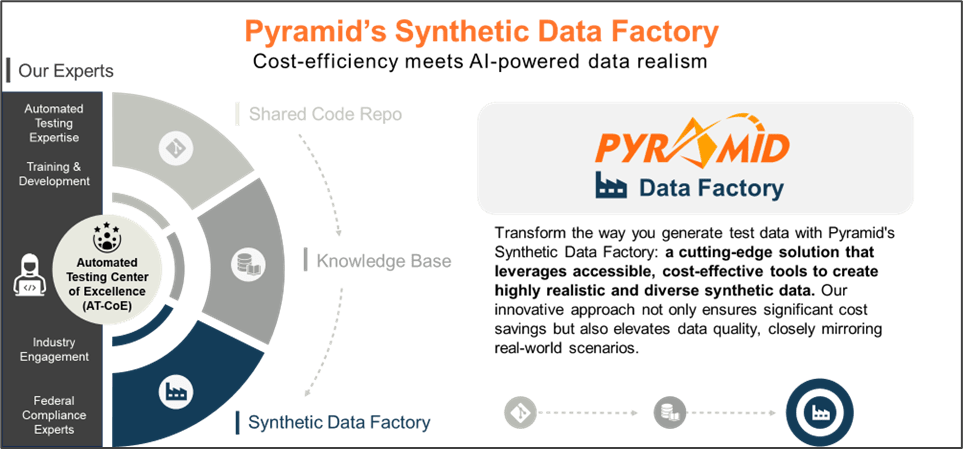
Synthetic test data is structured, AI-augmented generation of realistic but fabricated records that preserve the statistical properties of production data without copying production rows. The principle: match the shape, not the rows.
A useful synthetic data pipeline in federal context produces records that:
Conform to the production schema. Same fields, same types, same constraints. The records pass database validation without modification.
Preserve referential integrity. If a case references an applicant who references an organization, all three records exist and reference each other correctly.
Reproduce field-level distributions. The synthetic ZIP code field has the same geographic distribution as production. The synthetic income field has the same median and tail. The categorical fields have the same class proportions.
Reproduce joint distributions. The correlation between income and ZIP code is preserved. The implicit rule that certain combinations of fields don't co-occur is preserved.
Cover the long tail. Synthetic data can over-sample rare-but-important cases at controlled rates — protested awards, appeals, security incidents — that real samples wouldn't include in usable volumes.
Carry zero PII risk. No real person, household, or organization is referenced. The data is statistically realistic and individually invented.
This is what AI augmentation contributes. Statistical models trained on production distributions can generate fields and records that look real because they match the patterns of real data — without ever including a real row.
Why Federal Context Adds Constraints
Generic commercial synthetic data tooling is not always fit-for-purpose for federal use. The constraints that matter:
Regulatory categories of sensitive data. Federal records include classifications (CUI, PII, PHI, criminal-justice information, tax-return information) that govern how data can be used, stored, and processed — including by the data-generation pipeline itself. The synthetic pipeline cannot be a way to launder regulated data into less-regulated environments.
Schema fidelity to system-of-record. Federal mission systems are systems of record. Their schemas are governed, versioned, and tied to statutory and regulatory definitions. Synthetic data has to match the schema exactly, not approximately.
Mission-specific edge cases. Federal systems serve mission-specific populations and case types that generic synthetic generators won't model well. Custom modeling of the edge cases is part of the engagement, not an afterthought.
Audit traceability. The pipeline that produces synthetic data is itself an audit subject. It needs documented inputs, deterministic configuration, and provenance that survives an IG review.
What Changes When Synthetic Data Works
The operational shifts when a federal team gets the synthetic data layer right:
Test environments at production scale. The lower environment can carry the same row count as production, so performance issues surface in test rather than at go-live.
Faster refresh cycles. New data can be generated on demand, on schedule, or in response to schema changes — without waiting for the next masked extract.
Coverage of edge cases that production samples would miss. The team can deliberately test the rare paths that matter most.
PII risk removed from lower environments. Real records do not leave production. The classification of the lower environment can drop accordingly, simplifying ATO scope and reducing audit surface.
Test-data sharing across teams becomes safe. Developers, contractors, and external collaborators can work against the same synthetic dataset without the data-handling rules that govern real production extracts.
The downstream effect: defects move earlier in the lifecycle. The “it works on my machine” gap closes — not because developers got more careful, but because the test environment finally looks like production.
How Pyramid Systems Builds Synthetic Data Pipelines
Pyramid embeds synthetic data work inside federal DevSecOps engagements when test-data quality is the bottleneck — which is often. The components we deliver:
Schema-driven generators. Field-level constraints, type rules, and referential integrity captured from the production schema as the spec.
Distribution-preserving modeling. Where statistically appropriate, generators are trained on production distributions inside the production boundary, then exported as configuration — not as data — to generate records elsewhere.
Edge-case libraries. Mission-specific edge cases captured as templates with controllable injection rates — so the team can run a regression with 0.5% protested-award records or 5% protested-award records on demand.
Pipelines as code. The generation pipeline is versioned, peer-reviewed, and runnable on demand. The audit trail of what data was generated, when, and with what configuration is captured by default.
Integration with the rest of DevSecOps. Synthetic data fits into the same CI/CD pipelines, the same monitoring, and the same compliance posture as the rest of the engagement.
Conclusion
The “it works on my machine” meme isn't really about machines. It's about data — specifically, the gap between the data engineers see in test and the data production actually delivers. Closing that gap with synthetic data is the unlock most federal delivery teams underinvest in until a high-profile defect forces the conversation.
Pyramid Systems builds synthetic test data into federal DevSecOps engagements as a default, not an option. Better test data means earlier defect detection, faster delivery cycles, lower compliance surface, and a real change in how the team feels about every release. The pattern scales across mission systems, grants platforms, case-management environments, and acquisition tooling.
FAQ
What is synthetic test data?
Synthetic test data is structured, AI-augmented generation of realistic but fabricated records that preserve the statistical properties of production data without copying real rows. It conforms to the production schema, preserves referential integrity and joint distributions, covers long-tail edge cases at controllable rates, and carries zero PII risk.
Why doesn't masking production data solve the test-data problem?
Three reasons. Masking is imperfect — indirect identifiers and cross-field correlations re-identify masked records more often than masking governance acknowledges. Refresh cadence is slow, so test data drifts away from production. Edge cases under-represent because rare-but-important records often don't survive sampling at any reasonable extract size.
Does AI generate identifiable people in synthetic data?
Not when the pipeline is designed correctly. Distribution-preserving models can produce records that look like real data because the field-level and joint distributions match — but no actual person, household, or organization is referenced. The model learns shape, not identity. Pyramid's synthetic pipelines are explicit about not copying production rows.
How does synthetic data fit into a federal ATO posture?
It simplifies it. When lower environments never contain real PII or other regulated data, the classification of those environments can drop — reducing the controls, evidence, and continuous-monitoring scope required. The synthetic-data pipeline itself becomes the audit subject, with documented inputs and deterministic configuration.
Where does Pyramid Systems integrate synthetic test data?
Inside federal DevSecOps engagements where test-data quality is the bottleneck. Components include schema-driven generators, distribution-preserving statistical modeling, mission-specific edge-case libraries, version-controlled generation pipelines, and full integration with the CI/CD and monitoring already running on the engagement.
More from Pyramid Systems on federal IT modernization — practical perspectives on AI, cloud, DevSecOps, and mission delivery.
DEVSECOPS
01 July 2025
Building a Federal AWS Environment with Terraform & DevSecOps
How Pyramid built a secure, compliant multi-account federal AWS environment with Terraform IaC, custom Control Tower capabilities, and DevSecOps pipelines.
Pyramid Successfully Develops a Data Pipeline to Drive ML/AI Models
How Pyramid Systems built an adaptable end-to-end data pipeline on Google Cloud Platform — ingestion, transformation, feature engineering, model deployment.