Federal innovation has a familiar failure mode. An agency runs a pilot. The pilot demonstrates the technology. The pilot ends, and the technology never reaches the people who would actually use it. The reasons are usually structural: the prototype wasn't designed with ATO in mind, the ops handoff wasn't planned, the adoption model wasn't built, or the funding for productionization never appeared.
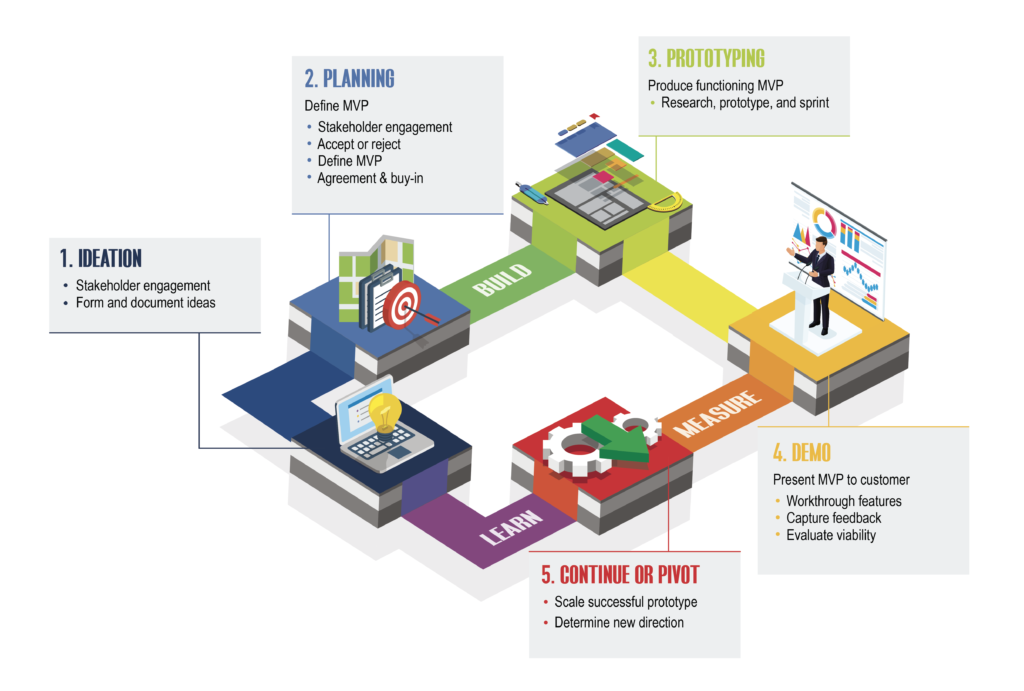
Pyramid Labs is Pyramid Systems' answer to that gap. It is a lean-startup-style innovation function that takes federal mission challenges through compressed cycles — from idea, to validated prototype, to production-ready solution — with the production path designed in from day one, not after the fact.
This post is for federal CIOs, CTOs, innovation officers, program directors, and mission users who have lived through prototype-to-production failures and want a different pattern. It covers what Pyramid Labs actually does, the principles that distinguish it from a generic R&D function, and how agencies engage with it without standing up their own lab from scratch.
The Gap Between Prototype and Production
The hardest part of federal innovation is not the innovation. It is the productionization that has to follow. Three failure patterns recur:
The orphaned prototype. The pilot works. The pilot demo gets compliments. Nobody owns the path to production. The prototype lives on a developer's laptop, a contractor's server, or a forgotten S3 bucket. Six months later, the agency has nothing to point to.
The ATO cliff. The prototype was built on infrastructure, with patterns, and using libraries that won't pass an ATO review. Production requires a rebuild, and the rebuild gets scoped as a separate effort — one that often dies in procurement.
The adoption desert. The technology works. The mission users don't trust it, don't have time to learn it, weren't part of the design, and the change-management work to bring them along was never funded.
The Pyramid Labs principle: every prototype is designed against these three failure modes from the moment it starts. The production path is part of the prototype, not a separate project that follows it.
Lean-Startup Discipline Applied to Government Constraints
The lean-startup playbook — build, measure, learn, with short cycles and validated learning — transfers to government, but the surface conditions are different. Three adaptations:
1. Validated learning includes regulatory validation. A prototype isn't “done validating” just because mission users say they like it. It also has to validate against the regulatory environment it will live in — ATO posture, Privacy Act compliance, accessibility, records-retention obligations. Pyramid Labs runs the regulatory validation in parallel with the user validation, not after.
2. Short cycles, long horizons. The cycles are weeks, not months. The horizons are years, because government adoption operates on agency budget cycles, not startup pivot cycles. The cycles produce decisions; the horizons produce outcomes. Both have to be respected.
3. The customer is plural. A commercial startup talks to one customer. A federal innovation engagement has to satisfy mission users, program managers, security officers, contracting officers, and authorizing officials — each with veto power. Pyramid Labs treats this as a design constraint, not a problem to route around.
What Pyramid Labs Actually Does
The lab's portfolio spans the dimensions where federal innovation has the most leverage:
Applied AI for federal mission domains. The work that produced AIR-Quire as a productized acquisition AI platform started in the lab. The pattern — narrow use case, regulated data handling, paired delivery, audit-by-default — is the lab's house style.
Emerging technology evaluation. RPA, generative AI, vector search, data-cataloging, large-scale embedding pipelines — the lab evaluates emerging technology in federal context, identifying what is ready for production, what is two years out, and what doesn't survive contact with regulated environments.
Reference implementations. Production-quality reference architectures that other engagements inherit — the federal AWS landing zone playbook, the GCP ML pipeline pattern, the synthetic test data toolkit.
Workforce development. The lab is where Pyramid interns and junior engineers work alongside senior staff on real federal problems — the same workforce model documented across our federal engagements.
Production by Default
The lab's most distinctive practice: every prototype is designed against production constraints from the start. What that looks like:
Infrastructure that matches production. Prototypes run on the same cloud baselines (NIST 800-53 aligned, FedRAMP-authorized services) we use for production engagements. There is no “prototype cloud” that gets retired when production starts.
Patterns that will pass ATO. Encryption, logging, IAM, network segmentation — baseline from day one. A prototype that wouldn't pass an ATO at any size is a prototype that doesn't ship.
Audit and observability hooks. The telemetry that an operations team would need is in the prototype, not deferred. By the time the prototype reaches mission users, the dashboards, alerts, and logging conventions are already in place.
Documentation as a deliverable. ADRs, runbooks, and decision records are produced alongside the code, designed for the team that will inherit the system — not for the team that built it.
The result: the “productionization” phase that traditionally follows a prototype is significantly compressed, because most of the productionization work was the prototype.
How Federal Agencies Engage With Pyramid Labs
Agencies don't need to stand up their own lab to benefit. Three engagement models work:
Productized capability adoption. Capabilities that exited the lab as products — including AIR-Quire — are awardable through Pyramid Systems' federal contract vehicles (GSA OASIS+, HHS CMS SPARC, SEC ONE IT, GSA 8(a) STARS III, FDIC ITAS III, HUD O&M BPA) and on the Tradewinds Solutions Marketplace.
Joint innovation engagements. An agency mission challenge becomes a defined lab engagement — weeks to months of compressed-cycle work, with the production path designed in. Often funded through an existing modernization contract rather than a new procurement.
Reference architecture transfer. An agency that already has internal engineering capacity can adopt Pyramid Labs reference patterns — federal AWS landing zones, GCP ML pipelines, synthetic test data toolkits — as documented architecture and accelerate their own work without building from scratch.
Conclusion
The bottleneck on federal innovation isn't ideas. It is execution against a regulatory, operational, and adoption environment that traditional R&D models weren't built for. Pyramid Labs exists because we needed a way to take federal mission challenges from idea to deployment without surrendering the lessons of lean-startup discipline or the constraints of regulated delivery.
Every capability the lab produces — AIR-Quire, the reference architectures, the workforce-development model — carries this pattern. Federal agencies that want innovation without the orphaned-prototype risk can engage the lab through productized adoption, joint engagement, or reference-pattern transfer. Each model collapses the prototype-to-production gap that kills most government innovation.
FAQ
What is Pyramid Labs?
Pyramid Labs is Pyramid Systems' innovation function — a lean-startup-style team that takes federal mission challenges from idea to validated prototype to production-ready solution in short cycles. Its distinctive practice is that every prototype is designed against production constraints (ATO posture, audit traceability, ops handoff, mission-user adoption) from day one rather than after the fact.
Why do most government innovation programs fail in the prototype-to-production gap?
Three common patterns: the prototype gets orphaned because nobody owns the path to production; the prototype hits an ATO cliff because it was built on infrastructure and patterns that won't pass review; and mission users were never part of the design, so the technology lands without the trust or training to be adopted. Pyramid Labs is designed against all three.
What capabilities have come out of Pyramid Labs?
AIR-Quire, our federal acquisition AI platform, is the most visible example — productized inside the lab and now deployed at HUD and awardable through multiple federal contract vehicles. The lab also produces reference architectures (federal AWS landing zones, GCP ML pipelines, synthetic test data toolkits) and evaluates emerging technology for federal readiness.
Do federal agencies need their own innovation lab to benefit?
No. Three engagement models work without an internal lab: adopting capabilities that exited the lab as products through Pyramid's federal contract vehicles; running joint innovation engagements where a defined agency mission challenge becomes a compressed-cycle lab project; or adopting Pyramid Labs reference patterns as documented architecture for an agency's own internal engineering teams.
How does Pyramid Labs handle ATO and compliance during prototyping?
By treating compliance as a design constraint from day one. Prototypes run on the same federal-aligned cloud baselines we use for production, follow the same encryption, IAM, logging, and network-segmentation patterns, and produce the documentation and telemetry that an ATO review will eventually ask for. Productionization is therefore short — not because the controls were skipped, but because they were always there.
Breaking Barriers: Advancing Federal AI Adoption and Innovation
How federal agencies can clear the four real barriers to AI adoption — procurement, data, skills, and governance — and turn pilots into mission-grade systems.