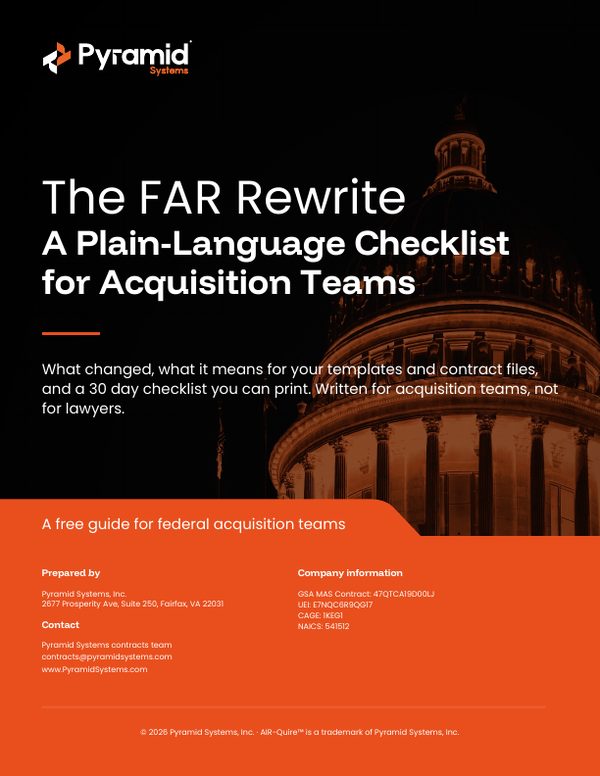
Free guide for acquisition teams

The FAR Rewrite

A plain-language checklist for acquisition teams

The FAR is being rewritten, under what GSA and OFPP call the Revolutionary FAR Overhaul, while you work from it. Your office may have the printed FAR, an agency class deviation and a proposed rule all open at once. This guide shows which one governs, what the fixed-price default changes, and where to look in your own templates.

  • Which text governs today, explained on one page
  • What the fixed-price default changes, with the dates that matter
  • A 30 day checklist you can print. No budget or new system needed
  • What the second batch of proposed rules changes in Parts 12, 15 and 16
  • Five questions to ask any vendor selling AI for acquisition, with our own answers
Get the guide

Free PDF, about 15 minutes to read. Updated October 19, 2026, the day the second comment window closed. We take you straight to it and email you a copy.

We will not add you to a mailing list or pass your name to anyone. One person on our team may write once to ask whether it helped.

What is inside

  1. Start hereThree versions of one clause, and why only one of them governs what you sign.
  2. What is changing, on one pageThe two stages of the rewrite and where your agency’s class deviation fits.
  3. The fixed-price defaultExecutive Order 14402, the July deadlines, and who signs when a buy is not fixed price.
  4. Your templates, clauses and contract filesWhere the rewrite touches your day, so you find the problems on purpose.
  5. Your 30 day checklistFour weeks, a few tasks each. Built to print.
  6. Three things to tell your teamThe part to forward if you forward only one.
  7. Five questions for vendors selling AIShort questions that sort the serious vendors from the rest. We answer the same five ourselves in the section that follows.
  8. Where to look it upThe public sources behind every line, starting with acquisition.gov.

From the first pageEvery section opens with the person doing the work.

A contract specialist opens the solicitation template her office has used for years. She needs one clause. She finds three answers: the clause as it is printed in the rule book, a different version in the class deviation her agency issued last year, and a third version in a proposed rule somebody forwarded her last month.

All three are real. Only one of them governs what she is about to sign. Nothing on her screen tells her which.

Questions

Get the guide
Is it really free?
Yes. There is no cost and no login. We ask for a name, an email and your agency so we know who is reading it.
What do I get?
A PDF you can read in about 15 minutes, with a 30 day checklist laid out to print. Every claim points to a public source you can check.
Who wrote it?
Pyramid Systems, an employee owned federal technology company that has worked with agencies since 1995.
Is this a sales pitch?
No. Pyramid builds AIR-Quire, software for federal acquisition teams, and the guide says so in a short note on the last page, and answers the same five questions it tells you to put to any vendor. Everything before that is useful whether or not you ever talk to us.
Can I share it with my team?
Yes. Send them this page, or forward the PDF.